Your journey
From your first evening class to your Green Badge.
The course is only the beginning. This is how assessment, in-car mentoring and the official DVSA tests fit together, and what happens if something does not go to plan.
01
Weeks 1 to 6, with quizzes to week 16
Part 1: theory and road law
Learn the Highway Code, road signs, hazard perception and road law, then sit a full timed Part 1 mock at the week 6 readiness gate.
Theory stays active through weekly spaced quizzes and a no-notice recap at the start of every session, so the knowledge is still sharp when you reach Part 3.
02
Weeks 3 to 16
Part 2: advanced driving
Move from competent driver to advanced driver: commentary driving, precision manoeuvres, independent routes and full DL25 mock drives.
A driving audit starts in week 3. The intensive driving block runs from week 5, with a Part 2 test window in week 11 and maintenance drives through to week 16.
03
Weeks 4 to 16
Part 3: teaching in the car
Build instructional ability through classroom micro-teaches, in-car role-play, real pupil practice and full Part 3 mock tests.
You teach from week 4. The fault-identification ladder moves from your own driving, to a peer, to a real pupil. Full Part 3 mocks run in weeks 14 to 16.
01Assessment and progression
Clear milestones, with support before any deadline.
The internal assessments exist to protect you. They show whether you are ready for the official tests before you book them, and they trigger support early if something slips.
Step 1 · Weeks 1 to 3
Foundations and baseline
Road craft, theory, hazard perception and the ADI role begin. A driving audit in week 3 sets your Part 2 starting point.
Step 2 · Weeks 4 to 6
Teach, drive and first gate
Micro-teaching begins, commentary driving develops, and the Part 1 mock becomes the first hard readiness gate in week 6.
Step 3 · Weeks 7 to 10
Role-play and second gate
In-car role-play, fault correction, two Part 2 mocks and the second readiness gate in week 10.
Step 4 · Weeks 11 to 16
Real pupils and final gate
The Part 2 test window, observed real pupil sessions, three full Part 3 mocks, the final readiness gate in week 15 and graduation in week 16.
If a readiness gate is not passed
A failed gate triggers the support process, not a removal from the course. Your tutor agrees a written home-study plan and a booster session, then re-checks the gate. Two consecutive reds or a missed session also trigger support.
Teaching builds in stages
Classroom micro-teaching starts in week 4, in-car role-play in week 7, and observed real pupil practice in week 12. You do not teach a real pupil until the Part 2 readiness gate is passed and your tutor has signed off your lesson planning and risk management.
02Teaching while you train
Pink Badge. Real pupils. Supported teaching.
A DVSA Trainee Licence lets you teach pupils under supervision while you prepare for Part 3. It is where the theory finally makes sense.
- Mentor-supported lessons with real learners, not role-play only.
- Access to dual-control vehicles through our fleet partners.
- Three full Part 3 mock instructional tests marked against the official competencies before you book the real thing.
- Help choosing between franchise placement and going independent.
We explain how vehicle access and franchise placement work before you commit to the next stage.
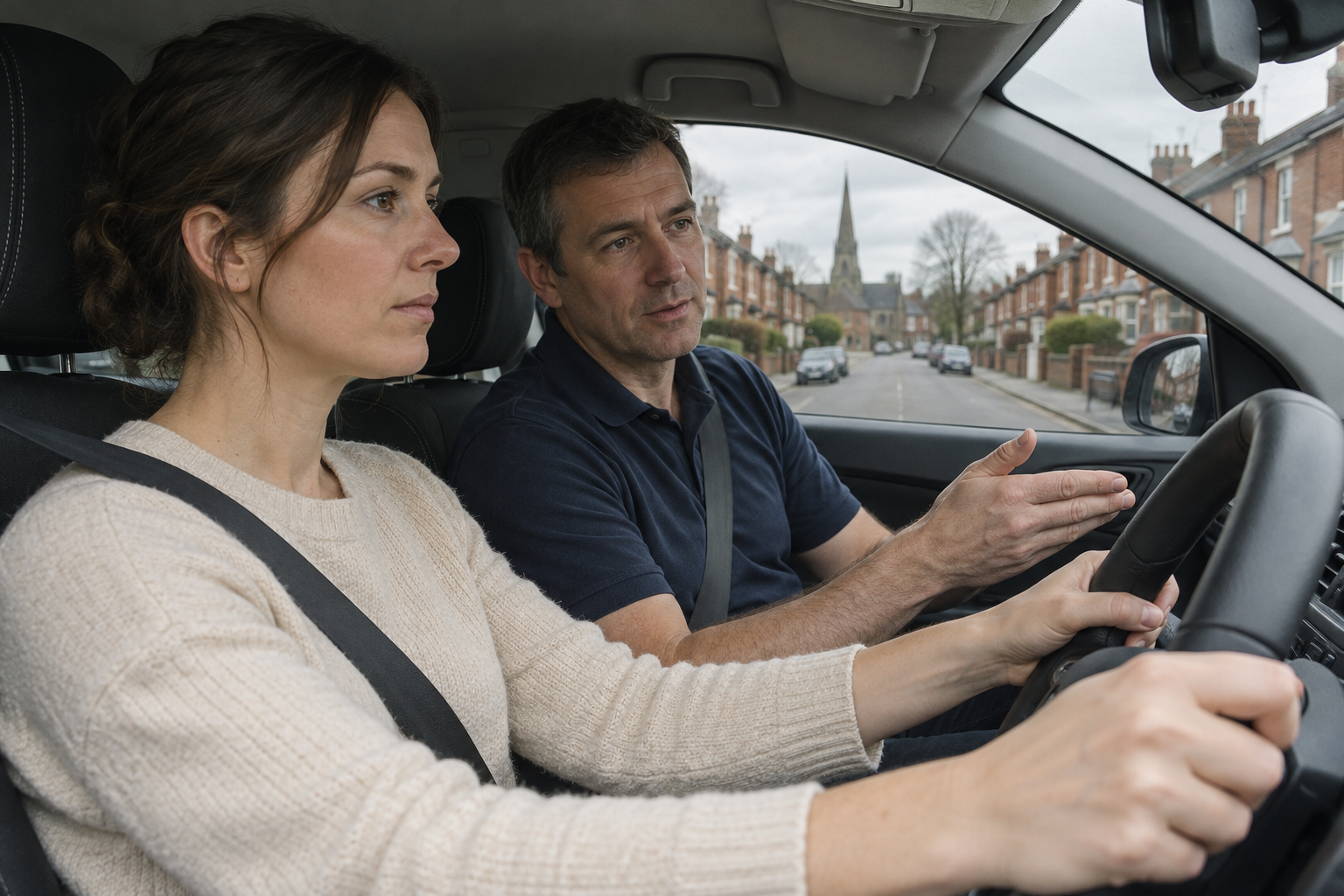
“Part 3 is about the pupil in front of you, not a perfect script.”
03Certification
What the certificate does, and does not, mean.
On completing the 16-week syllabus, readiness gates and internal mock assessments you graduate with the Level 2 Certificate in Creating a Business Start-Up if you took the funded business option.
The Level 2 certificate is a business qualification. It does not replace the official DVSA Part 1, Part 2 or Part 3 examinations, and it is not an ADI licence. Full Approved Driving Instructor status comes only from passing the DVSA Part 3 and receiving your Green Badge.
Start the conversation
Not sure whether you are ready for Part 1?
Talk to us about the entry requirements and what the first few weeks actually involve.
Evening study, two evenings a week